Start with the tool manual
Many pneumatic tools need oil in the air motor. Impact mechanisms, gears and bearings may have a separate lubrication point and a different lubricant. There is no single bottle or schedule that fits every tool.
Before maintenance, disconnect the air supply and relieve stored pressure as directed by the tool manufacturer. Find the model number, then check its manual for the lubricant type, quantity, application point and interval. A pencil grinder, impact wrench and angle grinder may all use compressed air while requiring different care.
Manual inlet oiling
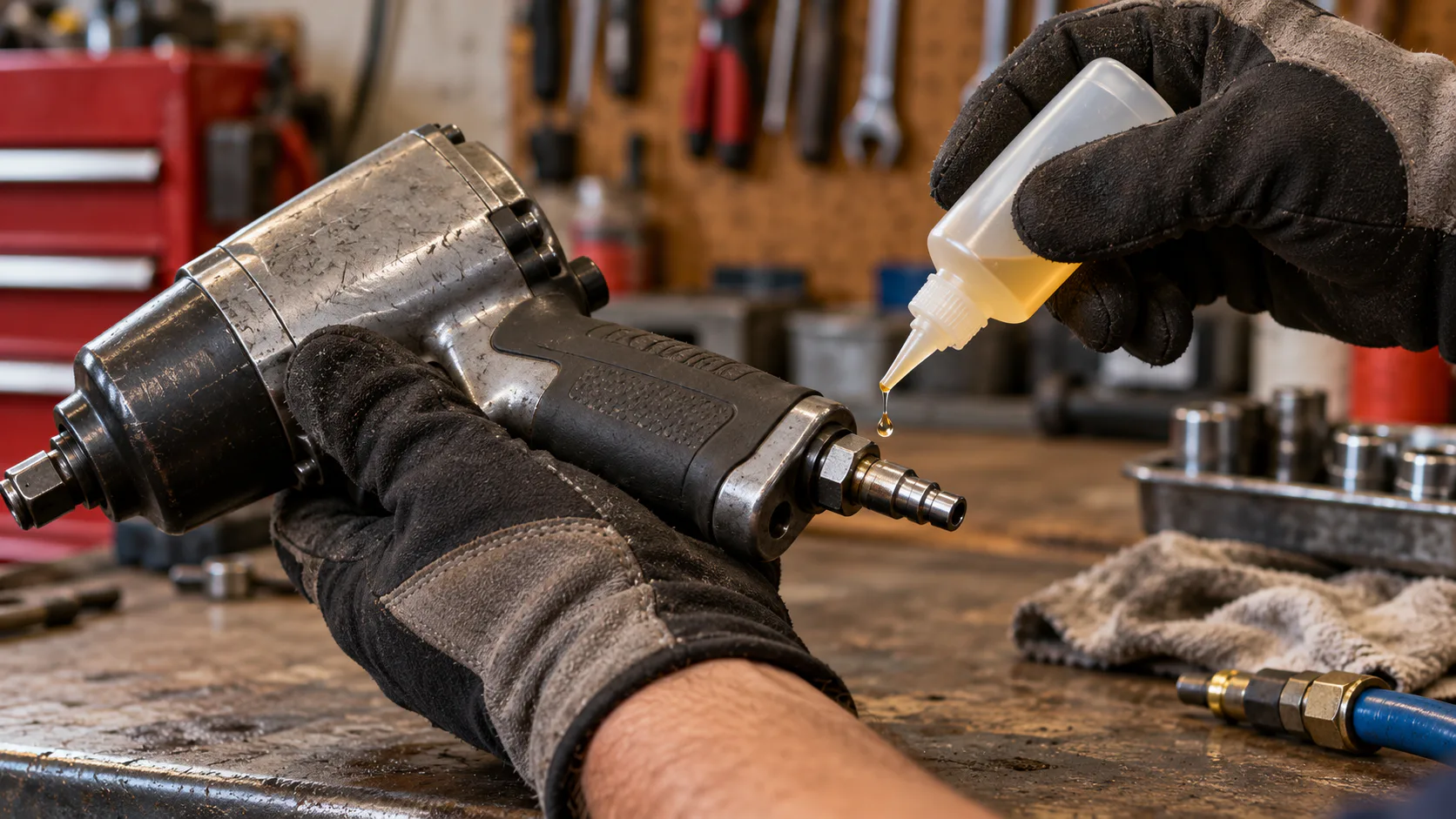
Tools without an approved inline lubricator are often oiled through the air inlet. The usual sequence is to disconnect the hose, place the specified amount of air-tool oil into the inlet, reconnect the air supply and run the tool only as its manual directs so the oil reaches the motor.
The quantity matters. Too little oil leaves moving surfaces without the film intended by the manufacturer. Pouring in extra oil can send a mist out of the exhaust and does not replace the separate lubricant used by an impact mechanism or gear set.
Manufacturer instructions illustrate why the model matters:
- Chicago Pneumatic tells users of manually lubricated tools to add air-motor oil to the inlet once a day and specifies SAE #10 oil in its air-line-lubricator guidance.
- Ingersoll Rand commonly calls for its #10 Air Tool Oil before use, during extended operation and before storage on supported impact wrenches.
- The Ingersoll Rand 2922 Series calls for 8 to 12 drops through the inlet for its pressure-fed air-motor lubrication system.
- Dynabrade says its air tools should be lubricated before use while identifying exceptions, including turbine pencil grinders.
Those examples are instructions for the products covered by each source. They do not create a universal drop count.
When an inline lubricator makes sense
An inline lubricator meters oil into the compressed-air stream. It can serve tools used regularly at one workstation when the tool maker permits continuous lubrication. Chicago Pneumatic gives an example setting of two drops per minute with SAE #10 oil for its supported setup.
Check the entire air path before installing one. A hose used downstream of a lubricator can carry oil, so it should not be casually moved to a paint gun, airbrush or another application where oil in the delivered air is unwanted. The filter, regulator and lubricator order, flow capacity and adjustment should follow the equipment instructions.
For portable or occasional work, manual inlet oiling may be easier to control. For a fixed production station, an approved lubricator can make the supply more consistent. The tool manual decides whether either approach is suitable.
Air-motor oil and impact grease do different jobs
Air-motor oil travels with the incoming air. Grease or heavier mechanism oil stays around gears, bearings, the hammer case or the anvil assembly. One does not automatically service the other.
| Exact equipment or component | Manufacturer-specified lubricant | Published instruction |
|---|---|---|
| Ingersoll Rand 2922 Series air motor | Ingersoll Rand #10 Air Tool Oil | 8 to 12 drops through the air inlet |
| Ingersoll Rand 258 impact mechanism | Ingersoll Rand No. 50 Oil | 1-3/8 oz (40 cc) after 48 accumulated trigger-hours |
| Ingersoll Rand 2922 Series impact mechanism | Ingersoll Rand #170 Grease | 4 cc through the grease fitting at the manual's stated interval |
Dynabrade tool marked with a W beside the fitting |
Dynabrade Gear Oil | Apply every 8 hours of operation |
| Supported Chicago Pneumatic angle grinder bevel gear | Mobilux EP-2 or equivalent | Apply at the bevel-gear service point |
The wording beside a fitting matters. Dynabrade uses the W mark to distinguish gear-oil applications from tools that receive Dynabrade grease. An unlabeled grease port should not be filled based on a similar-looking model.
Count working time correctly
An interval stated in operating hours refers to time the mechanism is actually running. Ingersoll Rand explains that a 48-hour impact-wrench interval means accumulated trigger time rather than two calendar days.
A simple maintenance note can record:
- Tool model and serial number.
- Lubricant and part number from the manual.
- Last service date.
- Estimated accumulated trigger time.
- Grease fittings or other service points completed.
This prevents a frequently used shop tool and an occasionally used home tool from being serviced on the same arbitrary calendar schedule.
Signs that call for an inspection
Loss of power, unusual noise or irregular operation can have several causes, including air pressure, hose restrictions, wear and lubrication. Do not diagnose the problem from one symptom alone.
Ingersoll Rand's impact-mechanism guidance shows a properly lubricated bushing with a thin, even coating. Dry areas or uneven coverage can indicate insufficient grease. The same guidance warns that too much grease can cause sluggish operation. If inspection requires opening the hammer case or another guarded component, use the service procedure for the exact model or send it to qualified service.
Oil also does not replace clean, dry air. Tank draining, filtration and moisture control address water and debris in the air supply. Our guide to water in a compressor and air tools covers that part of the system.
Sources checked
- Maintaining and Lubricating a Pneumatic Impact Wrench, Ingersoll Rand, checked 2026-10-12
- Impact Wrench Lubrication Procedure for High-Cycle Applications, Ingersoll Rand, checked 2026-10-12
- Maintaining Your 2922 Series Pneumatic Impact Wrench, Ingersoll Rand, checked 2026-10-12
- How and when to lubricate your tools?, Dynabrade, checked 2026-10-12
- Frequently Asked Questions, Chicago Pneumatic, checked 2026-10-12
Manufacturer pages can change. Recheck the exact manual before servicing a tool.