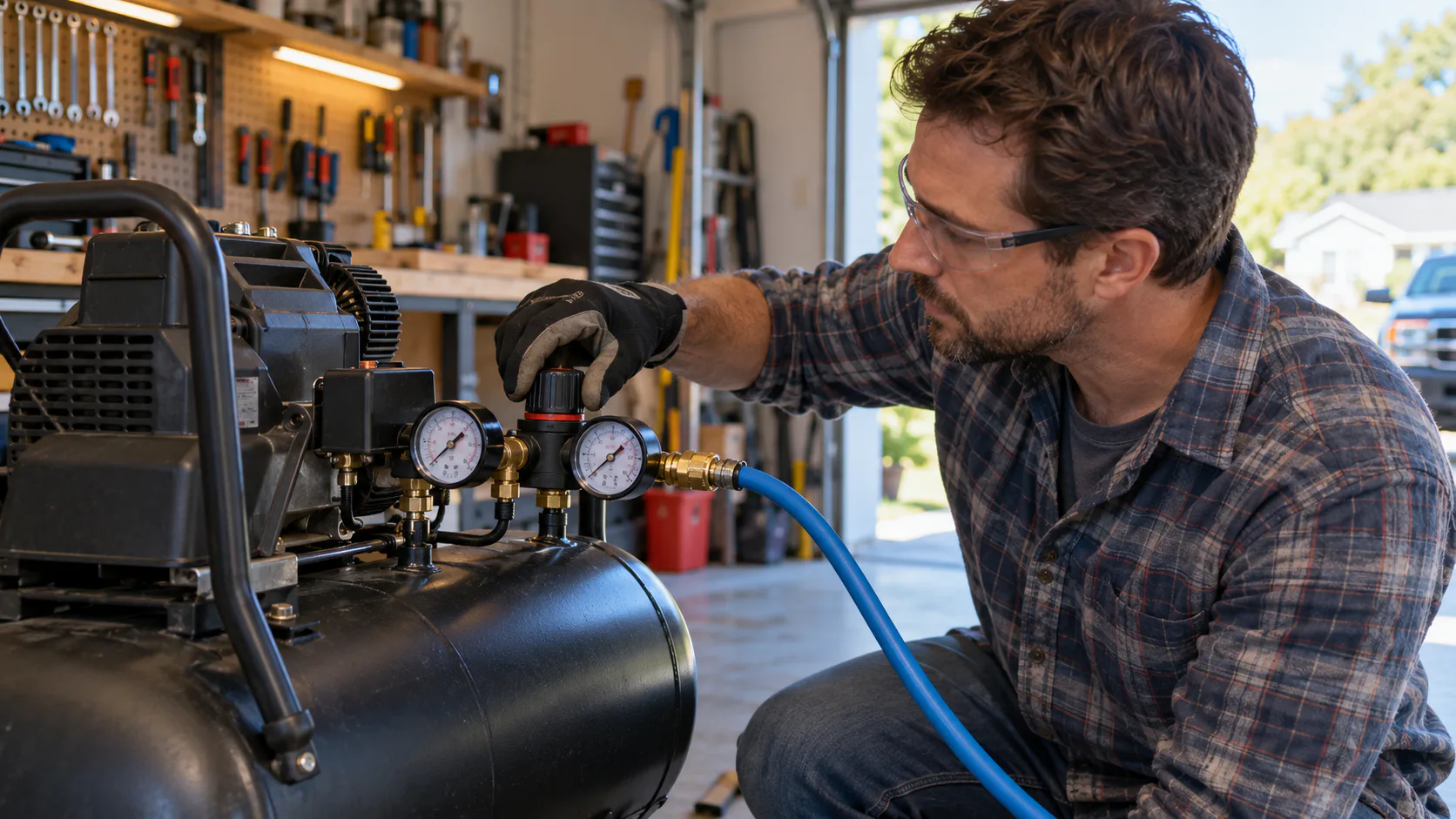
The water started as humidity in the room
An air compressor pulls in the same humid air that surrounds it. That air already contains water vapour. Compression packs the moisture into a smaller volume, and the compressed air becomes hot. As it cools in the receiver tank, hose or piping, some vapour changes into liquid condensate.
This is why a compressor can produce more water on a humid day and less in dry weather. It also explains why draining the receiver does not always remove every downstream droplet. More condensation can form after the air leaves the tank.
Work out where you see the water
The location narrows the check.
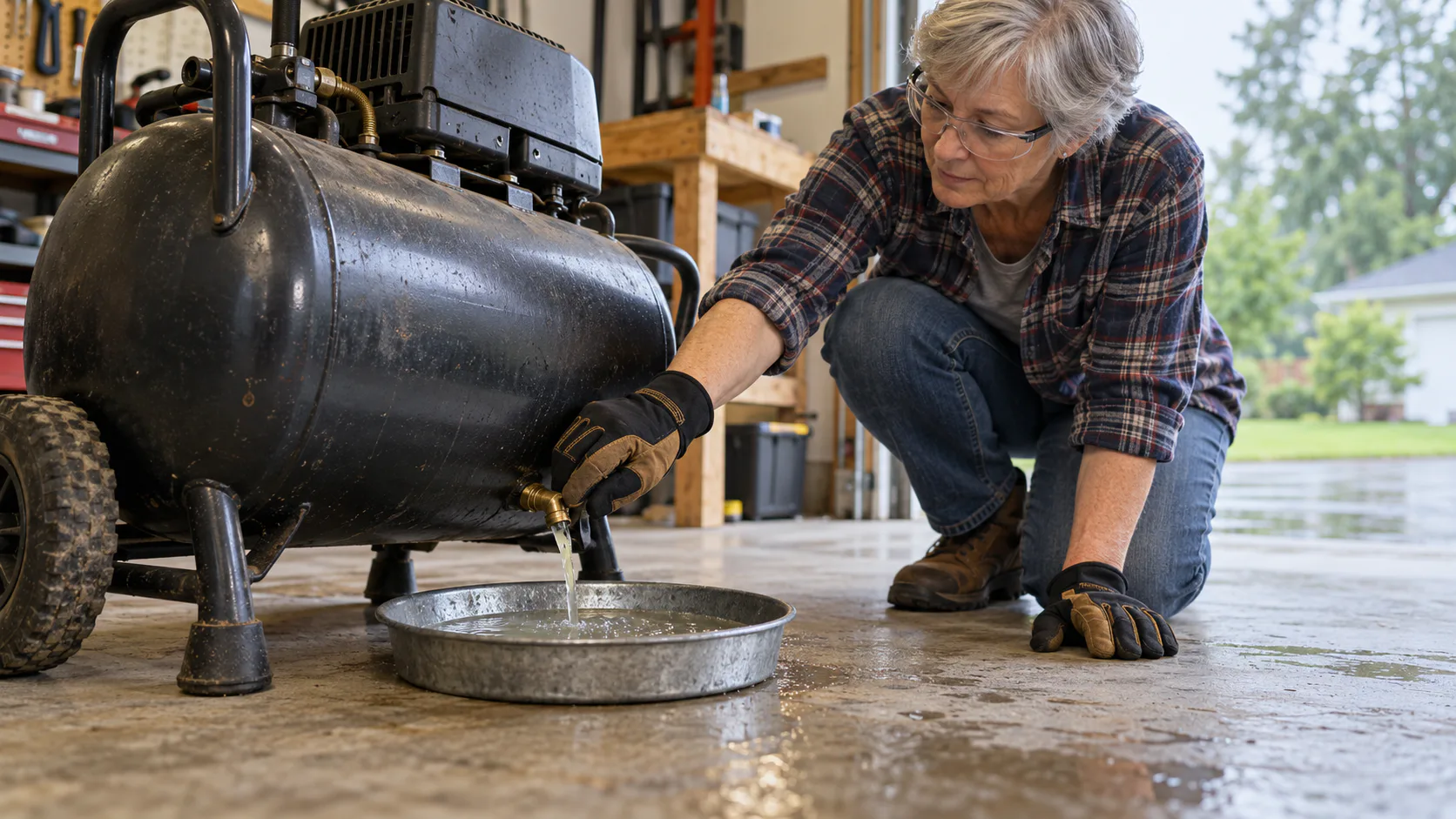
- Water at the receiver drain: the tank is collecting condensate as intended. Confirm that the drain opens, clears and seals according to the manual.
- Water in the hose: condensate may be leaving the receiver or forming as air cools in the line.
- Water at a filter bowl or separator: the device is catching liquid water. Drain or service it at the interval stated by its maker.
- Water from the tool exhaust: moisture has travelled through most of the air path. Check the receiver, separator, hose routing and point-of-use treatment.
- Water around a fitting or tank seam: stop and identify whether it is drain discharge, an external spill or a damaged component. Do not keep using equipment with significant corrosion, a damaged receiver or an uncertain leak.
Condensate does not follow only one route. It can remain in the tank, collect in a low point, enter a separator or travel toward the tool.
Drain the receiver using the model's procedure
The drain is usually at a low point on the receiver because liquid settles there. The safe sequence varies by compressor. Manuals may require shutdown, disconnection from power, cooling, reduction of tank pressure, eye protection and controlled opening of the drain.
Use the procedure printed for the exact model. Do not assume that a drain should be opened fully while the receiver is at maximum pressure. The discharge can carry water, oil residue, rust particles and debris.
Quincy Compressor describes daily condensate removal as a core receiver-maintenance task. Atlas Copco likewise explains that an undrained receiver can lose usable storage volume and expose the system to corrosion. Portable-compressor manuals may specify draining after use, particularly in humid conditions.
When draining:
- Move the compressor to a stable position where the outlet can discharge safely.
- Follow the manual's shutdown, isolation and pressure-reduction steps.
- Wear the protection specified by the manufacturer.
- Direct condensate into a suitable container.
- Open and close the valve only as instructed.
- Check that the drain seals after service.
- Dispose of condensate according to local requirements, especially when it contains oil.
If the drain is blocked, damaged or heavily corroded, stop and service it rather than probing a pressurized receiver.
Check the air path after the tank
A clean receiver drain may not solve water that forms downstream. Hot air can leave the compressor, cool inside the hose and create fresh condensate.
Start with the simplest parts:
- empty the receiver using the approved procedure;
- drain the filter or separator bowl;
- inspect the hose for low loops where liquid can collect;
- check fixed piping low points and drip legs if the workshop has them;
- place a point-of-use separator where the equipment maker recommends it;
- keep filters, bowls and drains within their pressure and temperature ratings.
Long hose runs and fixed piping need a deliberate layout. A separator works best on liquid droplets that have already formed. Air that is still hot can cool after passing the separator and create more water farther along the line.
Choose treatment for the job
General inflation and intermittent fastening may tolerate an air supply that would cause defects in painting or damage moisture-sensitive equipment. The required treatment depends on the job.
| Application need | Useful question to answer |
|---|---|
| General garage tools | Is the receiver drained and is bulk liquid being caught before the tool? |
| Spray finishing | What moisture and oil limits does the paint or gun maker specify? |
| Abrasive blasting | Is moisture causing media to clump or obstruct the system? |
| Airbrush or precision work | Does the equipment maker require a point-of-use separator, dryer or particular air quality? |
| Fixed shop distribution | Where will cooling occur, and where can liquid be collected and drained? |
A basic separator removes entrained liquid at its location. A refrigerated or desiccant dryer performs a different job and should be selected from the required pressure dew point, flow, pressure and operating conditions. Generic timer settings or dryer cycles cannot be transferred safely from one system to another.
Protect the tool as well as the tank
Water can promote corrosion and wash lubricant from parts that depend on a controlled oil film. Ingersoll Rand's pneumatic-tool maintenance guidance treats clean air, moisture management and correct lubrication as separate tasks.
After correcting the moisture source, check the tool manual. Some tools call for a specific air-tool oil after exposure to wet air. Others, including paint and air-treatment equipment, may have different cleaning instructions. Our guide to oiling pneumatic tools covers model-specific lubrication without treating oil as a substitute for dry air.
Visible flakes, deep rust, deformation or damage around a receiver, weld, fitting or drain deserve professional inspection. A receiver is a pressure vessel. Do not grind, drill, weld or patch it as a casual repair.
Sources checked
- How to Drain an Air Compressor, Quincy Compressor, checked 2026-10-12
- Why Is There Water in My Compressor?, Atlas Copco, checked 2026-10-12
- Condensate Management, Kaeser Compressors Australia, checked 2026-10-12
- Maintaining and Lubricating a Pneumatic Impact Wrench, Ingersoll Rand, checked 2026-10-12
Manufacturer pages can change. Use the exact compressor, drain, separator and tool manuals for operating steps and limits.