The short answer
Airflow at the nailer's operating pressure matters more than tank size alone.
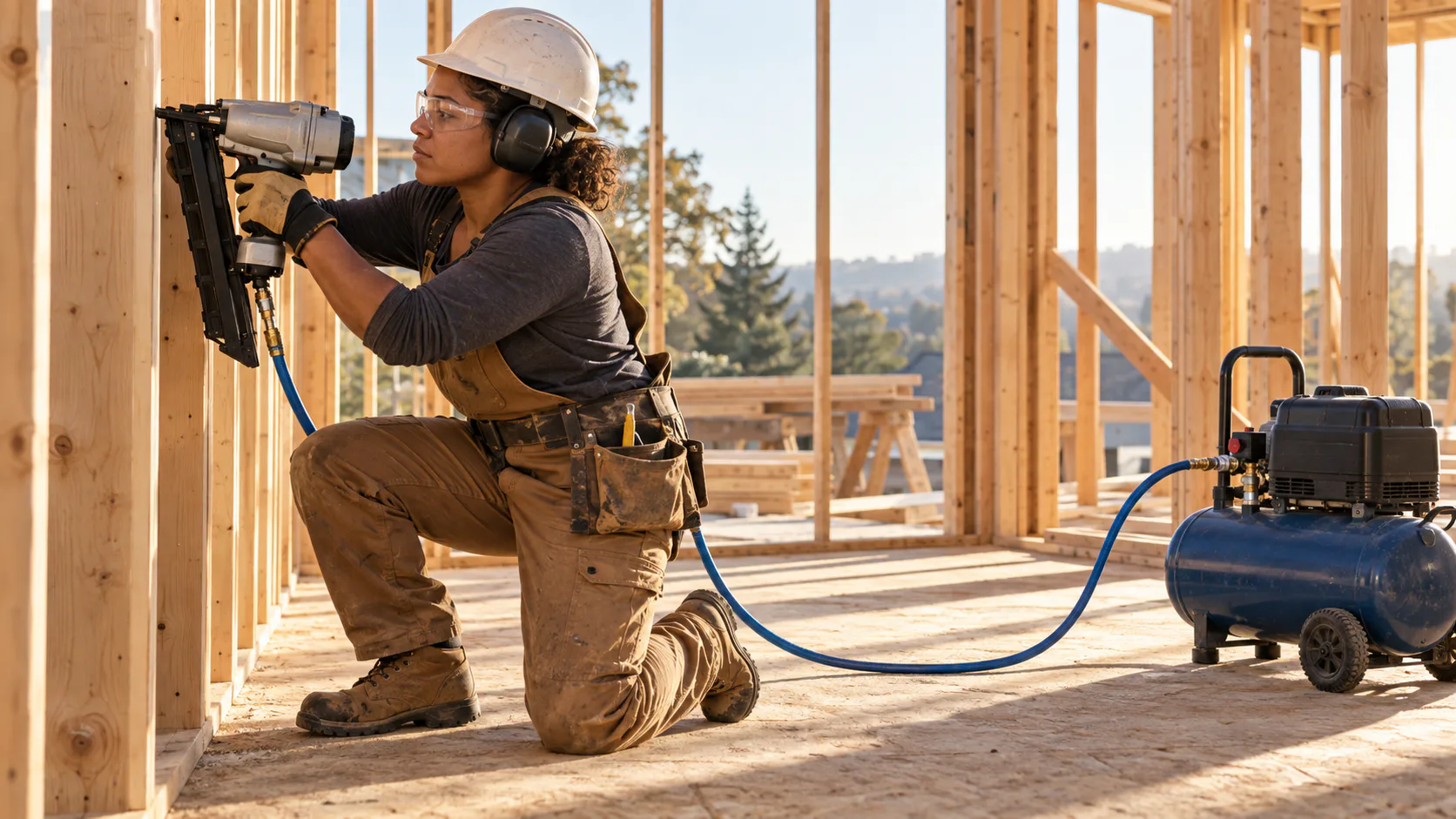
Paslode gives a worked example for two F-350S framing nailers, each driving 20 nails per minute at 90 PSI. The calculation comes to 3.95 CFM. At the same pace, one F-350S is approximately half that requirement, or 1.98 CFM at 90 PSI.
That is a rate-specific example for one nailer model. A different gun, a faster crew, or a different operating pressure changes the result. Start with the exact air-per-shot figure in the tool's manual, then compare the result with compressor delivery stated at the same pressure.
Paslode's compressor-sizing formula
Paslode publishes this formula:
Number of tools × nails driven per minute per tool × 1.2 safety factor × air per shot at the operating pressure
For two F-350S tools at 20 nails per minute and 90 PSI, Paslode uses 0.082 as the air-per-shot figure:
2 × 20 × 1.2 × 0.082 = 3.936
Paslode rounds and labels the result as 3.95 CFM at 90 PSI. For one F-350S at the same rate and pressure, halving that published two-tool result gives approximately 1.98 CFM at 90 PSI.
The source describes the air-per-shot input as SCFM, then labels its final compressor requirement as CFM. This guide preserves Paslode's final label rather than silently converting between CFM and SCFM.
At 120 PSI, Paslode's same two-tool example uses 0.108 per shot and produces a stated requirement of 5.2 CFM. The higher-pressure result cannot be compared with a compressor's 90 PSI output figure. Pressure and rating label have to travel with the number.
Compare the requirement with published 90 PSI output
The table below uses exact manufacturer records already held in the Air Tool Match catalogue. It compares their published CFM delivery at 90 PSI with Paslode's F-350S example. It does not claim that these compressors suit every framing nailer or every job-site setup.
| Compressor model | Published delivery at 90 PSI | Against the Paslode example |
|---|---|---|
| Metabo HPT EC914S | 4 CFM | Above the stated 3.95 CFM two-tool requirement |
| California Air Tools 2010ALFC | 3 CFM | Above the approximate 1.98 CFM one-tool requirement, below the two-tool requirement |
| Metabo HPT EC711S | 2.8 CFM | Above the approximate one-tool requirement, below the two-tool requirement |
| California Air Tools 8010 | 2.2 CFM | Above the approximate one-tool requirement, below the two-tool requirement |
| California Air Tools 1P1060S | 1.2 CFM | Below the approximate one-tool requirement |
| Metabo HPT EC28M | 0.8 CFM | Below the approximate one-tool requirement |
These are airflow comparisons, not complete equipment recommendations. Recovery time, hose and fitting restrictions, duty cycle, temperature, voltage supply, and the instructions for the exact nailer and compressor still matter.
You can inspect the source and check date for every model in the published-record directory, or use the matcher for exact records carrying compatible CFM and pressure labels.
What about pancake compressors and tank capacity?
“Six gallon” describes stored-air capacity, not delivery rate. Two compressors with the same tank size can publish different airflow at 90 PSI, so tank capacity cannot settle the comparison by itself.
The Metabo HPT EC914S is a useful exact example. Its manufacturer publishes a 6-gallon tank and 4 CFM at 90 PSI. Metabo HPT also specifically states that this model can simultaneously run two framing nailers or two roofing nailers. That is a claim about the EC914S, not a rule for every 6-gallon pancake compressor.
Some other pancake-compressor records use an SCFM label. DEWALT publishes 3 SCFM delivered at 90 PSI for the DWFP55130, while PORTER-CABLE publishes 2.6 SCFM at 90 PSI for the C2002. Air Tool Match keeps those records separate from CFM-labelled requirements because the published labels are not identical. The pancake-compressor output directory shows those source labels without normalizing them.
Quiet-compressor examples
Noise preference does not change the airflow check. Among the quiet models in the catalogue, California Air Tools publishes 1.2 CFM at 90 PSI for the 1P1060S, 3 CFM at 90 PSI for the 2010ALFC, and 5.3 CFM at 90 PSI for both the 4620AC and 10020C.
Against Paslode's worked pace, the 1P1060S falls below the approximate one-tool requirement. The 2010ALFC exceeds the approximate one-tool requirement but remains below the stated two-tool requirement. The 4620AC and 10020C exceed the stated 3.95 CFM requirement. Those results apply only to this numerical comparison at 90 PSI.
Sizing for a larger framing crew
Paslode also publishes an outdoor-system example for 10 tools driving 30 fasteners per minute at 100 PSI. Using 0.051 SCFM per shot, the calculation is:
10 × 30 × 1.2 × 0.051 = 18.36 SCFM
Paslode states that this example requires 18.36 SCFM at 100 PSI. It also gives a rule of thumb of approximately 1 horsepower for every 4 SCFM and calls for at least a 5 hp compressor in that example.
This crew calculation uses a different pressure and rating label from the 90 PSI F-350S example. Compare it only with equipment whose published output uses the same conditions, and have a qualified person review a multi-tool air-system installation.
Roofing and finish-nailer notes
This page does not have an exact roofing-nailer consumption record from which to calculate a general roofing requirement. The supported roofing evidence is narrower: Metabo HPT says its EC914S can run two roofing nailers, just as it says the model can run two framing nailers. Use the air requirement for your exact roofing nailer before transferring that result to another compressor.
Metabo HPT separately states that the same EC914S can run three 15- or 16-gauge finish nailers, or five 18-gauge brad nailers. Those are manufacturer-stated application counts for the EC914S. They are not evidence that every finish or brad nailer uses a fixed amount of air.
Hose sizing and pressure limits
Paslode says framing tools use 3/8 inch air fittings as a rule of thumb, while smaller tools such as trim nailers use 1/4 inch fittings. Its outdoor air-system instructions specify a minimum 3/8 inch inside-diameter hose and a 1/2 inch inside-diameter hose for runs over 25 feet.
Check the operating range and maximum pressure in the manual for your exact nailer. Paslode's outdoor-system guidance says its tools are designed to operate efficiently between 90 and 120 PSI and must not be operated above 120 PSI. Paslode also warns that compressor delivery falls as pressure rises.
Follow both manufacturers' instructions. Have a qualified person check plumbing, electrical work, and any multi-tool installation.
Sources checked
- Pneumatic 16 Ga Straight Finish Nailer FAQ | Paslode, rechecked 2026-10-07. This page contains Paslode's F-350S sizing examples and fitting guidance.
- F325R Compact Framing Nailer manual | Paslode, checked 2026-10-06. This manual contains the outdoor air-system examples and hose guidance.
- THE TANK EC914S | Metabo HPT, rechecked 2026-10-07.
- Air Tool Match compressor record directory, with exact manufacturer URLs and per-record check dates for every compared compressor.
Manufacturer pages can change. Recheck the manual and current specifications for the exact equipment before buying or installing it.