Start with the symptom, not the tank shape
A pneumatic grinder or sander may start strongly, then lose speed partway through a pass while the compressor keeps running. An undersized air supply is one possible cause. A restricted hose, small coupler, leak, regulator setting, clogged filter or compressor fault can create a similar result.
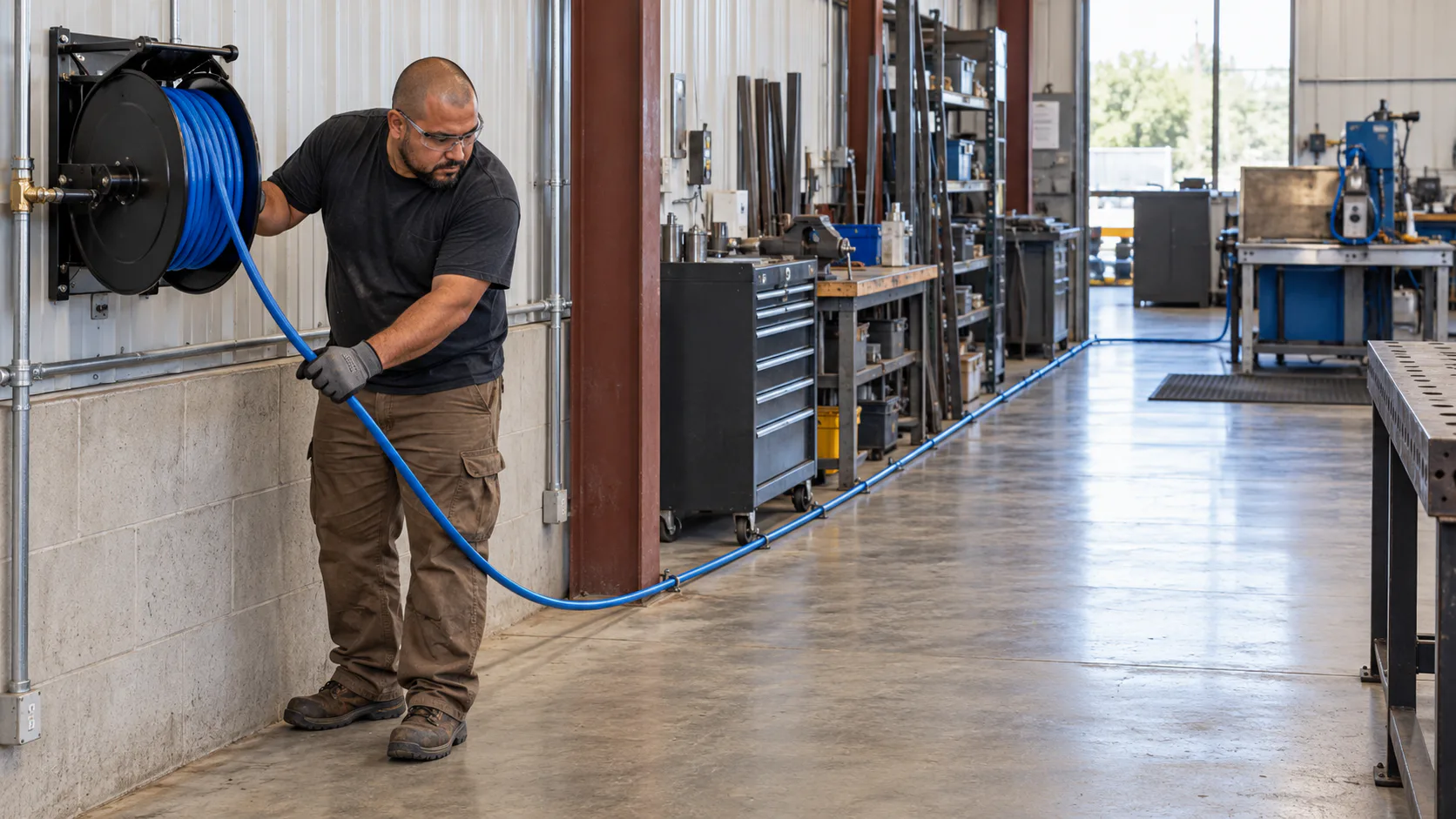
The useful first check is the pressure available at the tool while air is flowing. A gauge beside the compressor can still look healthy while pressure is being lost farther down the line. Our guide to hose length and inside diameter explains why the downstream pressure can differ from the tank or regulator reading.
If the compressor is overheating or running beyond the duty cycle stated in its manual, stop and let it cool. Do not raise the regulator above the tool, hose, fitting or compressor limits to compensate for a falling reading.
Read the label attached to each airflow number
Air-tool pages do not use one universal consumption field. Some publish Air Consumption, some publish Average Air Consumption, and some publish Air Consumption @ Load. Those labels are part of the specification.
| Tool | Manufacturer's published field | Published figure |
|---|---|---|
| Astro ONYX Micro High-Power 1/4-inch die grinder | Air Consumption | 3 CFM at 90 PSI |
| Astro 3035 belt sander | Average Air Consumption | 4 CFM at 90 PSI |
| Universal Tool UT8706-2 pencil grinder | Average Air Consumption | 4 CFM at 90 PSI |
| Astro 325 finishing palm sander | Average Air Consumption | 5.5 CFM at 90 PSI |
| Ingersoll Rand 99HL60H106 Type 1 grinder | Air Consumption @ Load | 84 CFM at 90 PSI |
The last row is the cleanest high-demand example because Ingersoll Rand explicitly labels 84 CFM as consumption under load. The three values labelled average cannot automatically be treated as full-trigger continuous demand. Their makers do not define average on those product pages as one shared duty-cycle formula.
That distinction matters. A compressor rated above a tool's average field has the larger published number, but that comparison alone does not prove the compressor will sustain the tool through a long grinding or sanding pass. The companion guide on average versus load CFM shows why the two fields stay separate in the matcher.
What a same-pressure comparison can tell you
Published numbers still help when their labels are kept visible.
The Metabo HPT EC711S publishes 2.8 CFM at 90 PSI. The Astro 325 publishes 5.5 CFM at 90 PSI under Average Air Consumption. Subtracting the two displayed figures gives a 2.7 CFM gap, but the result means only that the compressor's published delivery is 2.7 CFM below the sander's published average field. It is not a measured stall point.
The Makita MAC2400 publishes 4.2 CFM at 90 PSI. Against the same 5.5 CFM average field, the displayed gap is 1.3 CFM. Again, that is source-field arithmetic, not a guarantee of a particular runtime or sanding speed.
The labels can also prevent a bad comparison. The PORTER-CABLE C2002 publishes 2.6 SCFM at 90 PSI, while the Astro 3035 page publishes 4 CFM at 90 PSI. One source says SCFM and the other says CFM. The lower compressor number is an obvious reason to investigate further, but the records do not supply enough standard-condition detail to turn that pair into a precise deficit calculation.
Use the matcher to expose these differences. It compares selected published fields at the same stated pressure. It does not calculate hose loss, tank runtime or compressor duty cycle.
Why the tank helps only for a while
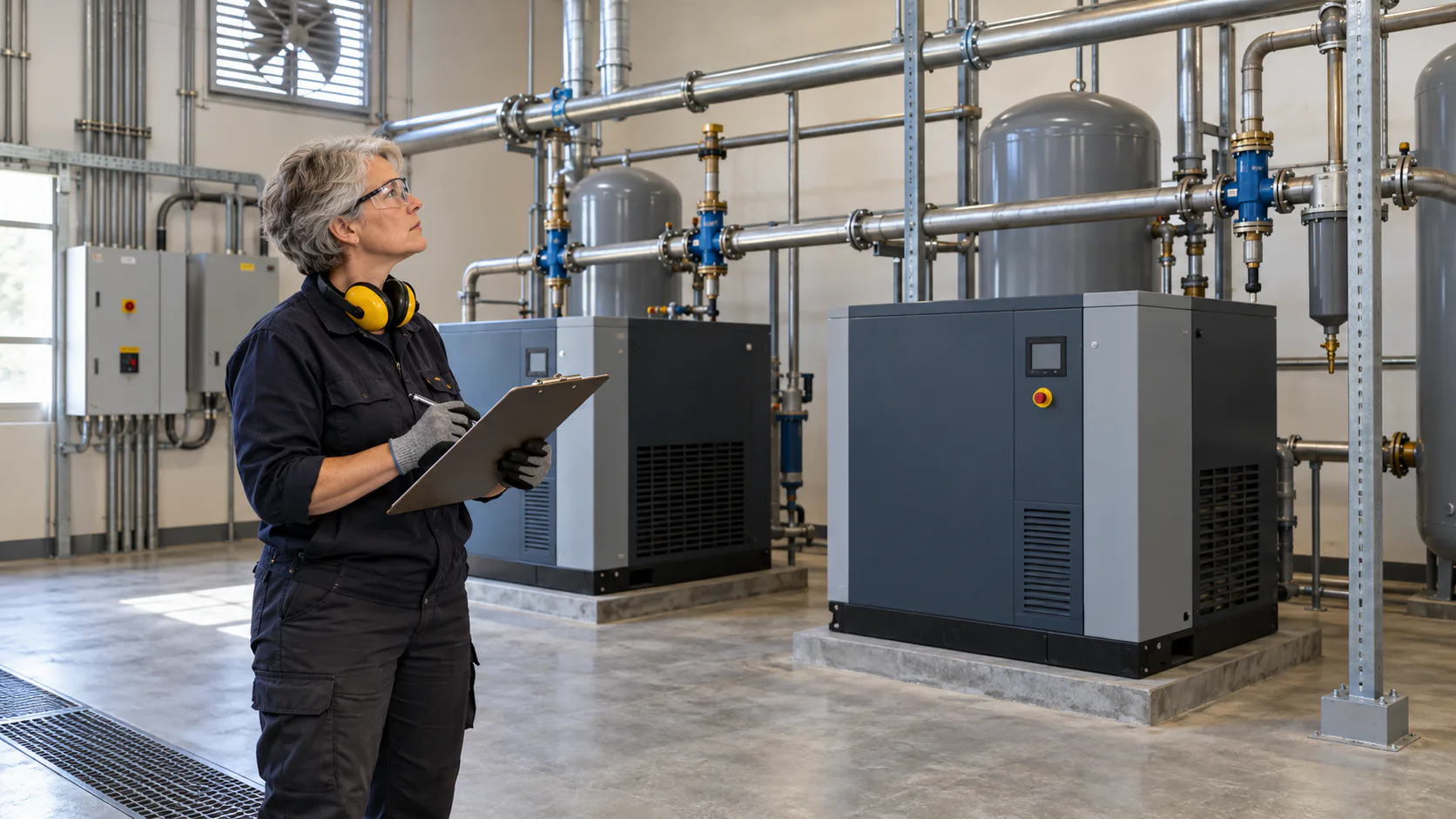
An air receiver stores compressed air. Atlas Copco describes the receiver as a buffer that can help a lower-CFM compressor meet a temporary higher demand.
That buffer is useful for short tool operation. Once air leaves the tank faster than the pump replaces it, stored pressure falls toward the pump's sustainable delivery condition. A larger receiver may extend the time before the tool feels that fall, but it does not change the pump's published airflow.
This is why buying a larger tank is not the same as buying a compressor with greater delivery. Tank size affects stored-air time. Pump delivery, operating pressure and duty cycle determine what the compressor itself can keep supplying.
A practical troubleshooting order
Work through the air path instead of changing several parts at once:
- Find the exact tool model and copy its airflow field, unit and stated pressure.
- Find the compressor's delivery at that same pressure. Do not substitute maximum PSI for delivered CFM or SCFM.
- Keep
average,under load,CFMandSCFMlabels intact. If the labels differ, record the limitation instead of inventing a conversion. - Check pressure near the tool while it is running. Inspect the hose, quick-connects, filter and regulator for restrictions or leaks.
- Check the compressor manual for its duty cycle, ventilation and cooldown requirements.
- Test a shorter or correctly sized air path if the manuals allow it, then compare the tool behaviour under the same work load.
This order separates a published-capacity mismatch from pressure lost between the compressor and the tool. It also avoids treating tank shape or maximum tank pressure as proof of usable airflow.
Choosing the next compressor
Start with the exact tool documentation. If the maker publishes both average and load consumption, inspect both. If it publishes only an average field, ask the tool maker what airflow should govern the length and type of work you plan to do.
Then compare compressor delivery at the same pressure and confirm that its duty cycle suits the expected run time. Leave room for documented system losses rather than treating equal catalogue numbers as a complete design.
For equipment selection or changes to plumbing and electrical supply, follow both manufacturers' instructions and have the setup checked by a qualified person.
Sources checked
- Air compressor requirements for air tools, checked 2026-10-07
- Astro ONYX Micro High-Power 1/4-inch die grinder, checked 2026-10-07
- Astro 3035 belt sander, checked 2026-09-24
- Astro 325 finishing palm sander, checked 2026-09-24
- Universal Tool UT8706-2 pencil grinder, checked 2026-09-24
- Ingersoll Rand 99 Series grinders, checked 2026-09-24
- Makita MAC2400, checked 2026-09-19
- PORTER-CABLE C2002, checked 2026-09-21
- Metabo HPT EC711S, checked 2026-09-21
Manufacturer pages can change. Recheck the exact model, field label, unit and pressure before making an equipment decision.