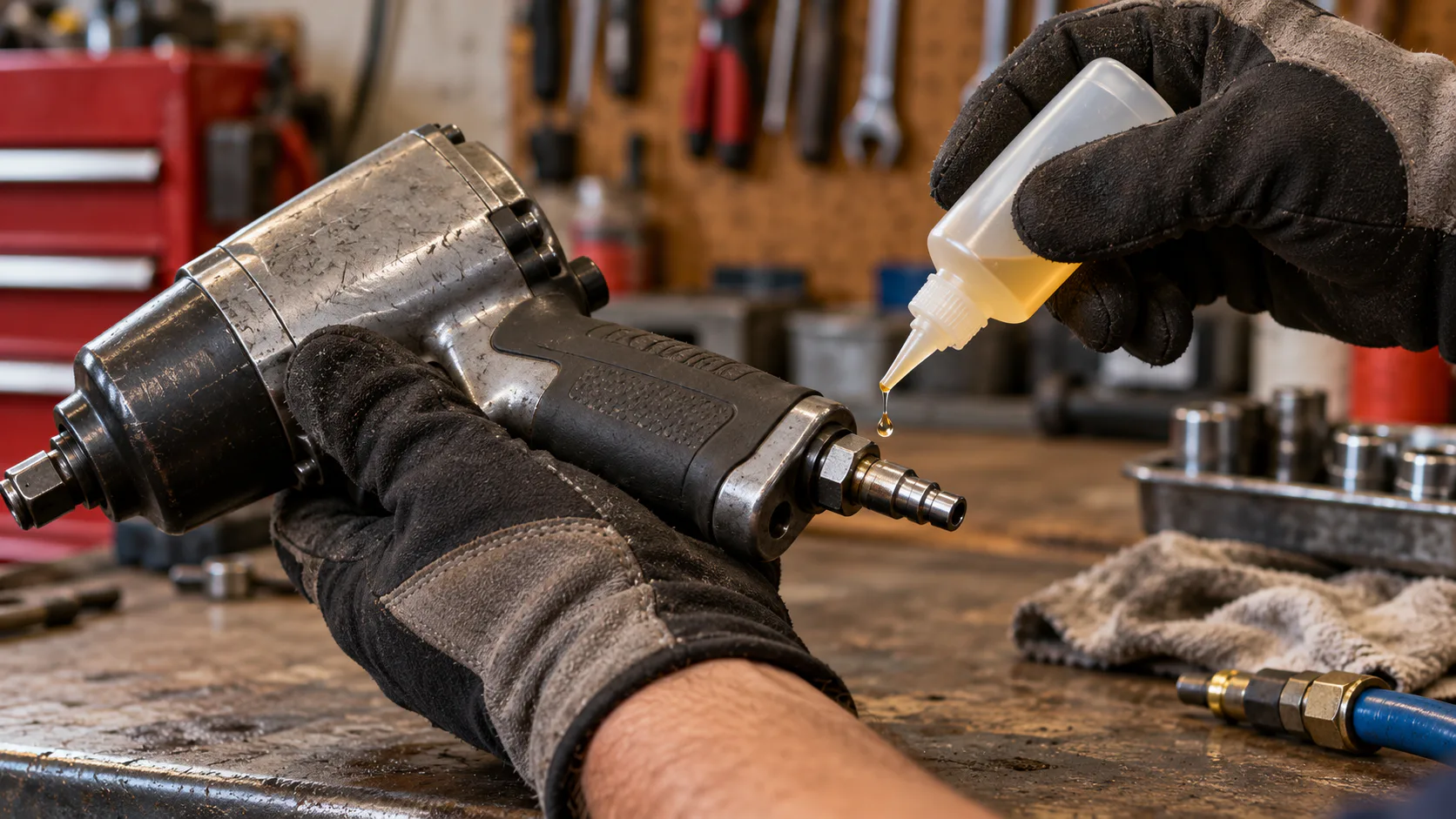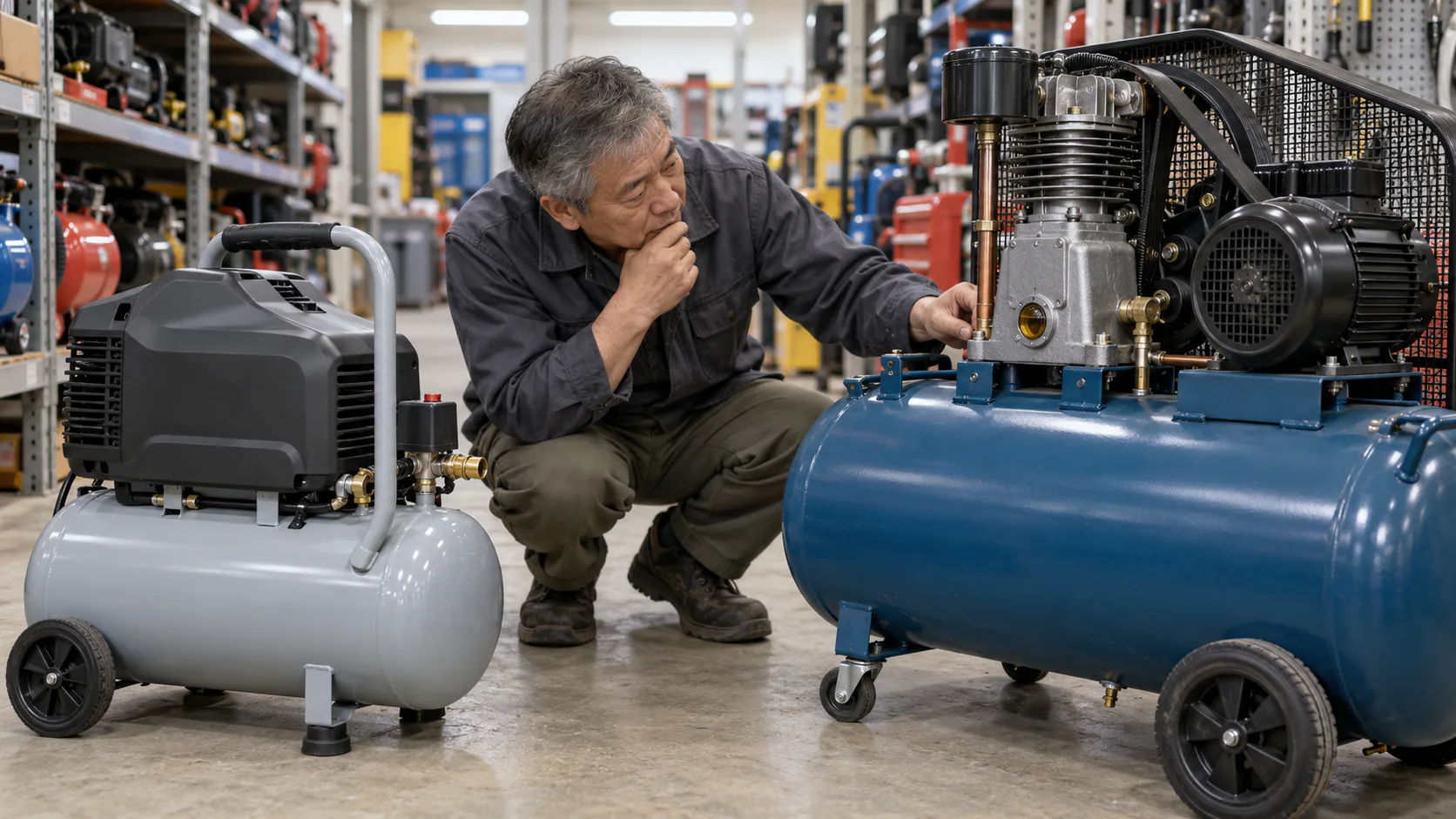
The label describes how the pump handles lubrication
An oil-lubricated compressor uses lubricant in the compression mechanism. An oil-free compressor is designed so oil is not introduced into its compression chamber during normal operation.
That distinction affects maintenance and the risk of lubricant entering the compressed-air stream. It does not settle every buying question. Both categories include small portable machines and larger industrial designs, and their noise, delivery, duty cycle, service life and price can vary widely.
A practical comparison
| Decision | Oil-free pump | Oil-lubricated pump |
|---|---|---|
| Pump-oil changes | No compression-chamber oil change | Oil level and change interval follow the manual |
| Routine work | Intake, condensate and model-specific service remain | Intake, condensate, oil and model-specific service |
| Delivered-air concern | Pump does not introduce its own lubricant into the compression chamber | Oil carryover must be managed for sensitive applications |
| Portability | Common among compact portable models | Available in portable and stationary designs |
| Noise | Compare exact-model dBA | Compare exact-model dBA |
| Service life | Depends on design, duty, heat and parts | Depends on design, duty, heat and maintenance |
The useful choice comes from the exact application and exact models, not a blanket winner.
Maintenance access
An oil-lubricated pump adds an oil-level check, approved lubricant and change interval. Some models use a sight glass; others use a dipstick or fill mark. The compressor manual defines the correct oil and service procedure.
An oil-free pump removes that oil-change task. It still needs condensate draining and intake maintenance. Belts, seals, cooling passages, check valves and other parts may also need inspection or replacement depending on the model.
Look at where the service points are located. A compressor that is easy to drain, inspect and obtain parts for may be a better long-term choice than one with a shorter checklist but poor service access.
Noise has to be compared by model
Manufacturer articles often describe one pump category as quieter, then describe specific product lines that reverse the generalization. The complete compressor matters: pump speed, enclosure, intake silencing, motor, vibration mounts and tank structure all affect sound.
Compare a published sound-pressure level in dBA when both manufacturers state one under usable conditions. Metabo HPT and California Air Tools, for example, publish sound figures for some oil-free portable models. That supports a comparison between those exact products, not a claim about every oil-free machine.
Workshop placement also changes what the user experiences. Distance, walls and an enclosed room can reduce or amplify perceived sound while creating separate ventilation and access requirements.
Air quality needs an application target
An oil-free compression chamber removes one potential source of lubricant carryover. It does not remove ambient dust, humidity, compressor wear particles or contamination from downstream hoses and piping.
Painting, food production, pharmaceuticals, instrumentation and breathing-air systems can have very different air-quality requirements. If the application requires a documented purity class, choose a complete compressor and treatment system certified for that requirement. A generic oil-free product label is not a substitute for certification.
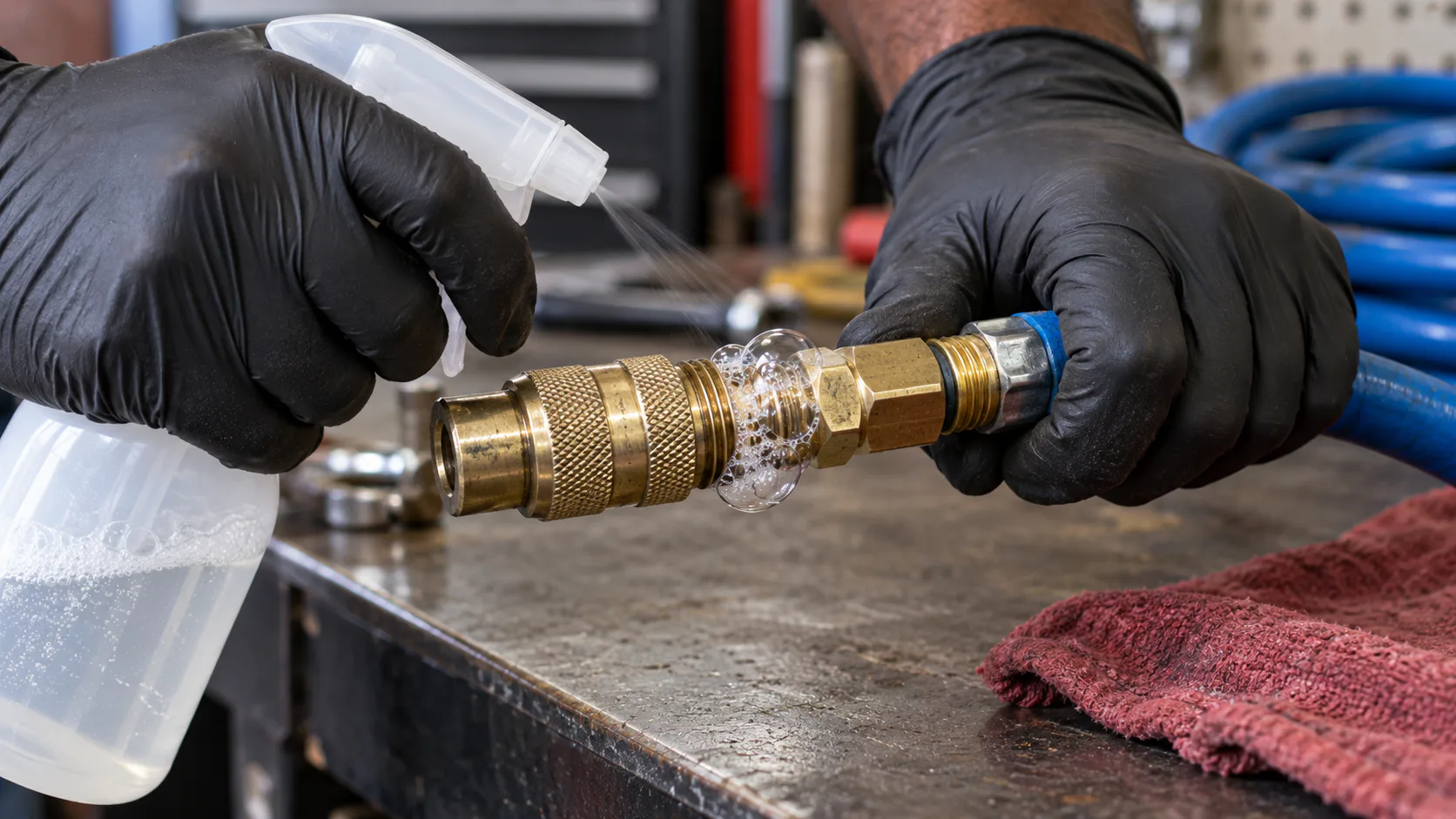
An oil-lubricated compressor can serve many workshop tools, but filters and separators must be selected for the job. A hose used after an inline tool lubricator should not be moved casually to an application that requires oil-free delivered air.
Delivery and tank size remain separate
Pump lubrication does not tell you how much air the machine delivers. Read the exact output at the pressure required by the tool.
The PORTER-CABLE C2002 and Metabo HPT EC28M are both oil-free portable compressors, yet their published delivery and receiver sizes differ. Larger oil-free shop compressors also exist. Oil-lubricated models cover a similarly broad range.
Use the compressor records to compare exact published fields and keep CFM or SCFM labels visible. The Air Tool Match calculator compares a selected tool and compressor at the same stated pressure. Delivery, tank capacity and pump lubrication should remain separate rows in the buying decision.
Match the design to the work
An oil-free portable model can suit trim work, inflation and mobile jobs when its published delivery meets the tool's demand. Low weight and fewer oil-service steps can matter when the machine moves often.
An oil-lubricated belt-driven model can suit a fixed workshop where the owner accepts oil service and values accessible, serviceable components. That still needs an exact look at duty cycle, output, voltage, noise and parts support.
For a sensitive-air application, begin with the required air-quality documentation. For ordinary pneumatic tools, begin with airflow, duty and service access. In either case, compare:
- Published delivery at the working pressure.
- Compressor duty cycle and intended service.
- Published sound level.
- Weight, wheels and electrical supply.
- Receiver size and drain access.
- Maintenance schedule and parts availability.
- Air-quality requirements for the actual job.
Sources checked
- Oil-Free vs Oil-Injected Compressors: Key Differences, Atlas Copco, checked 2026-10-12
- Comparing an Oil Lubricated and Oil Free Compressor, Atlas Copco, checked 2026-10-12
- Lubricated vs. Oil-Free Air Compressors, Quincy Compressor, checked 2026-10-12
- PORTER-CABLE C2002, checked 2026-09-21
- Metabo HPT EC28M, checked 2026-09-21
- California Air Tools 8010, checked 2026-09-19
Manufacturer pages can change. Verify the exact model's current delivery, duty, sound, service schedule and air-quality documentation before purchase.